



News
Oman's Poultry Buildout Meets 50°C Summers — What Closed-House Climate Control Has to Deliver
Source: TBBView: 108Oman's Poultry Buildout Meets 50°C Summers — What Closed-House Climate Control Has to Deliver
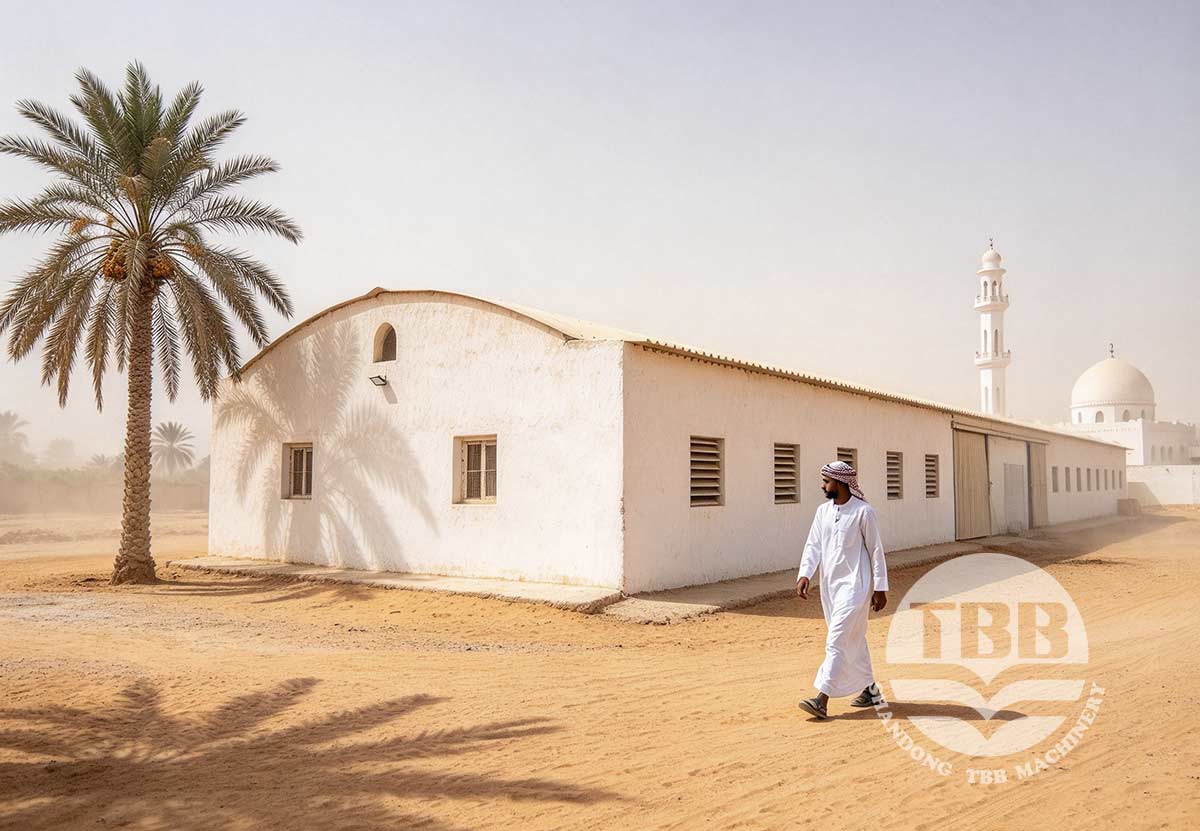
Oman is midway through a poultry buildout. Under the 11th Five-Year Plan that opened in 2026, the sultanate has queued roughly 400 investment projects worth about RO 4 billion, with close to 200 of them inside the livestock and fisheries sector. Al Dhahirah alone has signed seven investment contracts across more than 5,000 acres and around OMR 35 million, among them the Subul table-egg project, built on a cage system, at nearly 46 million eggs a year. A separate JBS–Oman Investment Authority venture, announced in February 2026 at US$150 million, has brought the A'Namaa poultry plant online. The catch is the season: these houses are rising where summer air routinely sits between 40°C and 50°C.
▶ The numbers show where the pressure sits
Oman's table-egg self-sufficiency already runs above 95% — five commercial producers turn out close to 970 million eggs a year, and parts of North A'Sharqiyah produce past 200% of local demand. Broiler meat is the shortfall. Self-sufficiency hovered near 62%, and the ministry has set a target of 74% or higher by the end of 2026, according to the Undersecretary for Agriculture, Dr. Hamad Al Bakri. Closing that gap means tens of millions of birds a year that currently arrive as imports. A buildout aimed there is, in practice, a buildout of broiler houses — and broilers are the most heat-sensitive class in the flock.
▶ Heat is the constraint you cannot design around by ignoring it
At 40–50°C birds eat less and drink far more, and they convert feed worse. Egg birds cut output and broilers lose feed-to-weight efficiency. Mortality climbs through sustained heat, and ammonia from wet litter rises as birds drink and excrete more. In Oman this is not a fringe risk that shows up once a decade. It is the baseline summer, every year.
▶ Moving air comes first
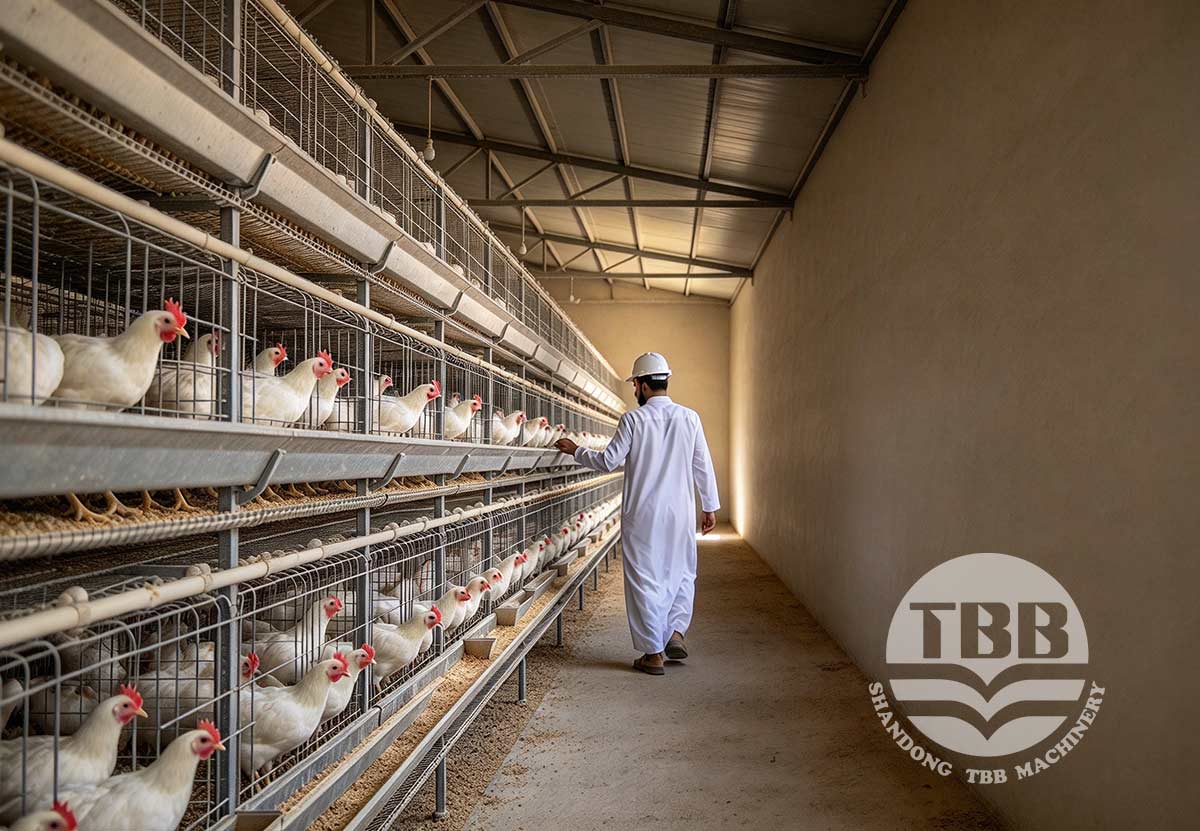
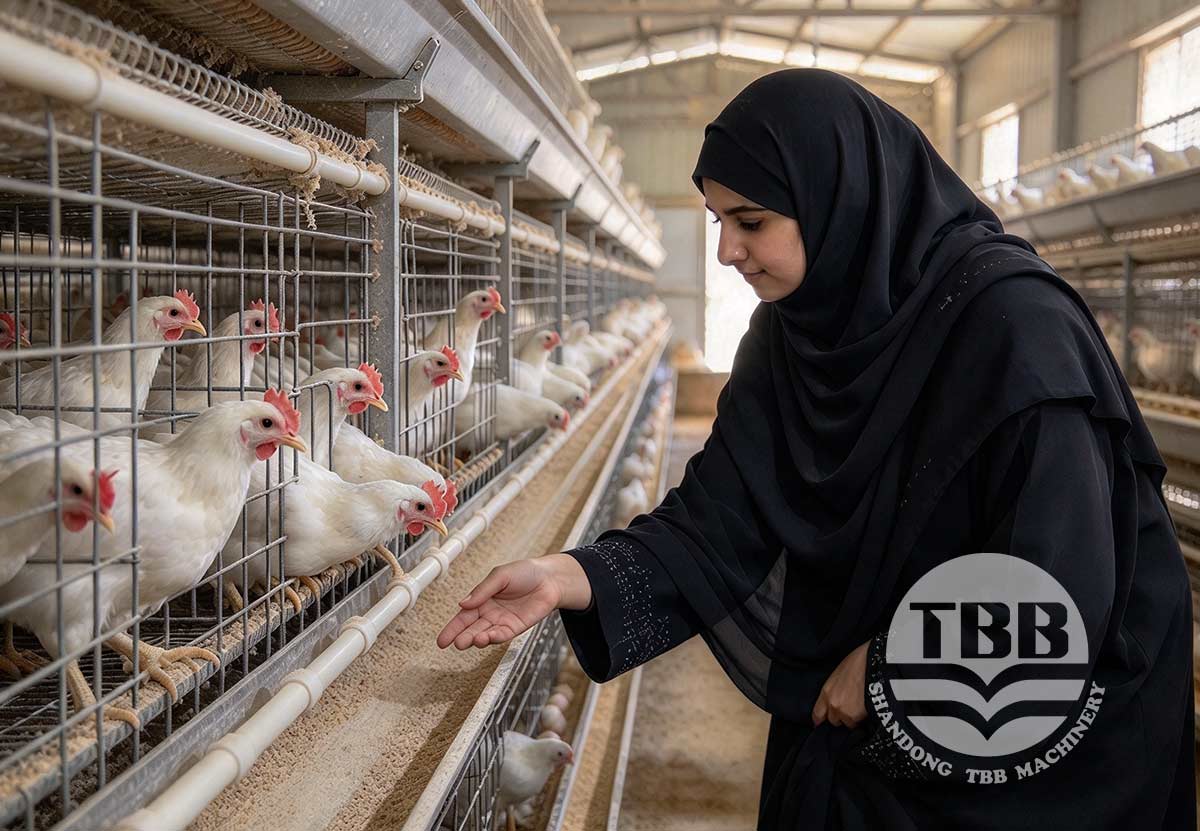
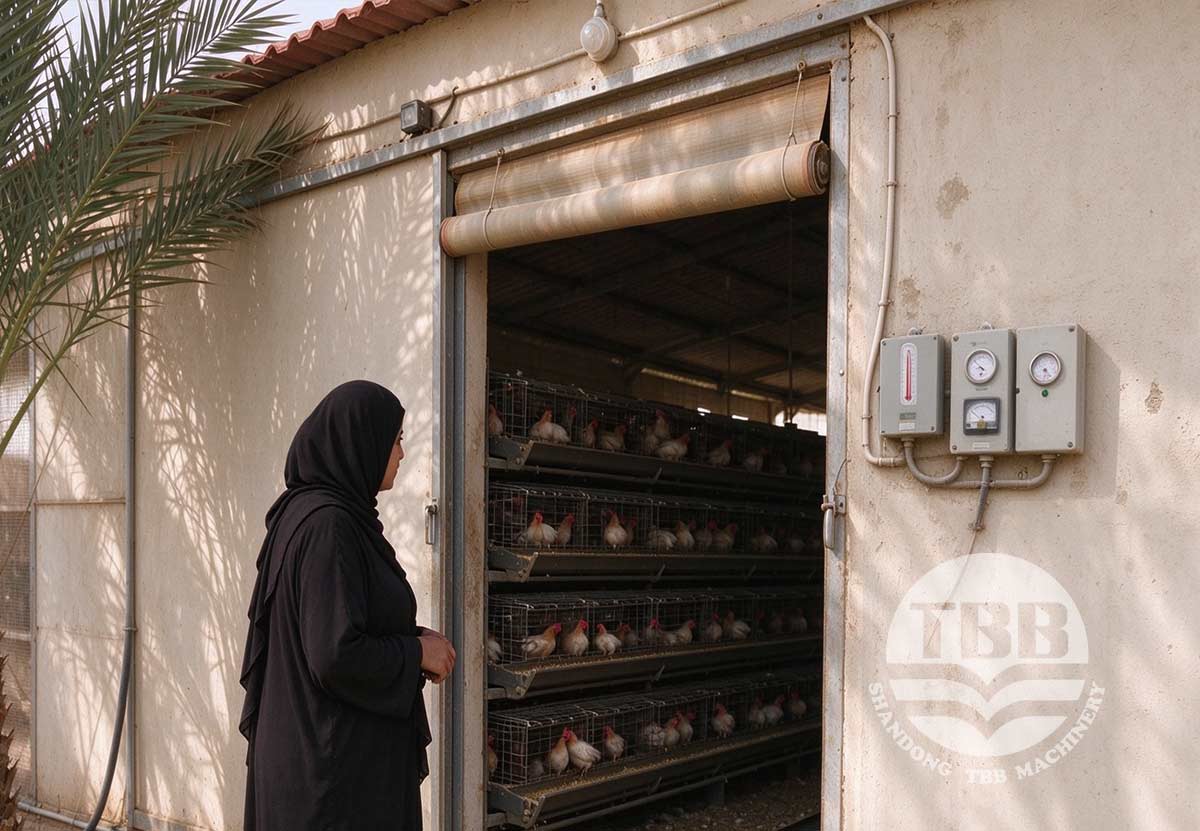
So what does a closed house actually have to deliver? Tunnel ventilation pulling air the length of the house, paired with evaporative cooling pads at the inlet, is what drags a 48°C afternoon down to a range the birds can bear. Well-run pad systems pull incoming air down 5–10°C, and tunnel airflow needs to reach roughly 2.5–3.2 metres per second at bird level to actually strip heat off the flock — a house that moves air but not fast enough just blows warm air around. The cage layout has to leave that air a clear path, rows set for airflow and not only for headcount, because a house packed to maximize stocking but starved of movement is the one that fails first when the temperature spikes.
▶ Then the envelope itself
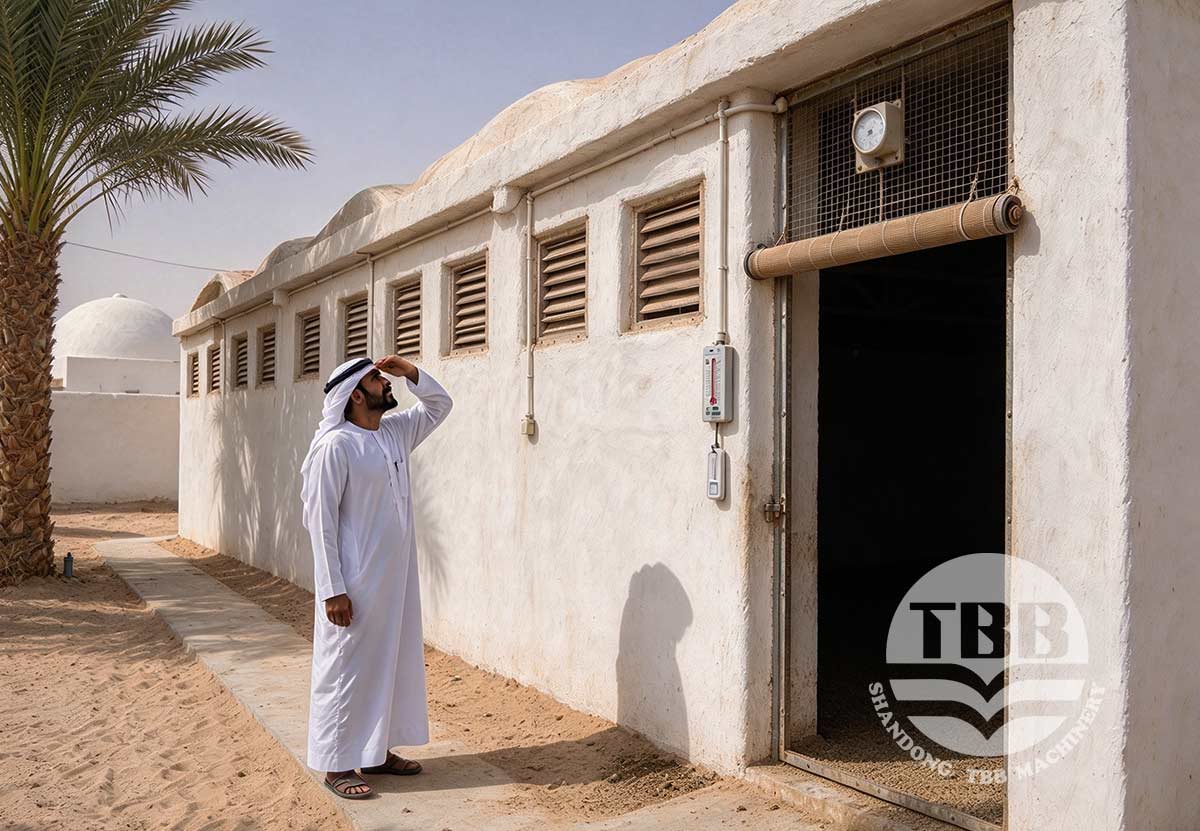
Insulated walls and roof shed the solar load before it reaches the birds, and environmental controllers tied to temperature, humidity and ammonia sensors hold the set points without someone walking the house every hour. In a market where labour is tight and the cost of a missed reading is a dead flock, automatic control is not a premium add-on. It is the only way the house keeps running through July.
▶ Water and waste close the loop
Nipple lines have to keep flow up when birds are drinking several times their cool-weather intake, and cool water matters as much as enough water — a bird drinking warm liquid in a hot house barely cools down. The manure belt beneath each tier has to clear droppings before ammonia climbs; above about 25 ppm, ammonia starts to cut production and bird health, so the belt is doing climate work, not just hygiene. Power sits underneath all of it: a ventilation fan that stops in a 50°C house becomes a flock-loss event within hours, so backup supply belongs in the climate plan from the start, not as a retrofit bolted on after the first outage.
▶ The demand is real enough that others arrived first
A Chinese supplier, Big Herdsman, has already commissioned a 400,000-bird table-egg unit plus a 100,000-bird rearing unit in Oman, marketing tunnel ventilation and smart environmental control built for exactly these conditions. That is competition, not coincidence — it shows the specification buyers here are already asking for. In Oman, climate control is the product, not a footnote.
None of this means a house that beats the desert outright.
It means one that keeps four loads — heat, air, water, waste — managed well enough that production holds through the worst weeks. The projects now breaking ground in Al Dhahirah and beyond will be judged on whether the climate system holds, not merely on whether the building stands.